

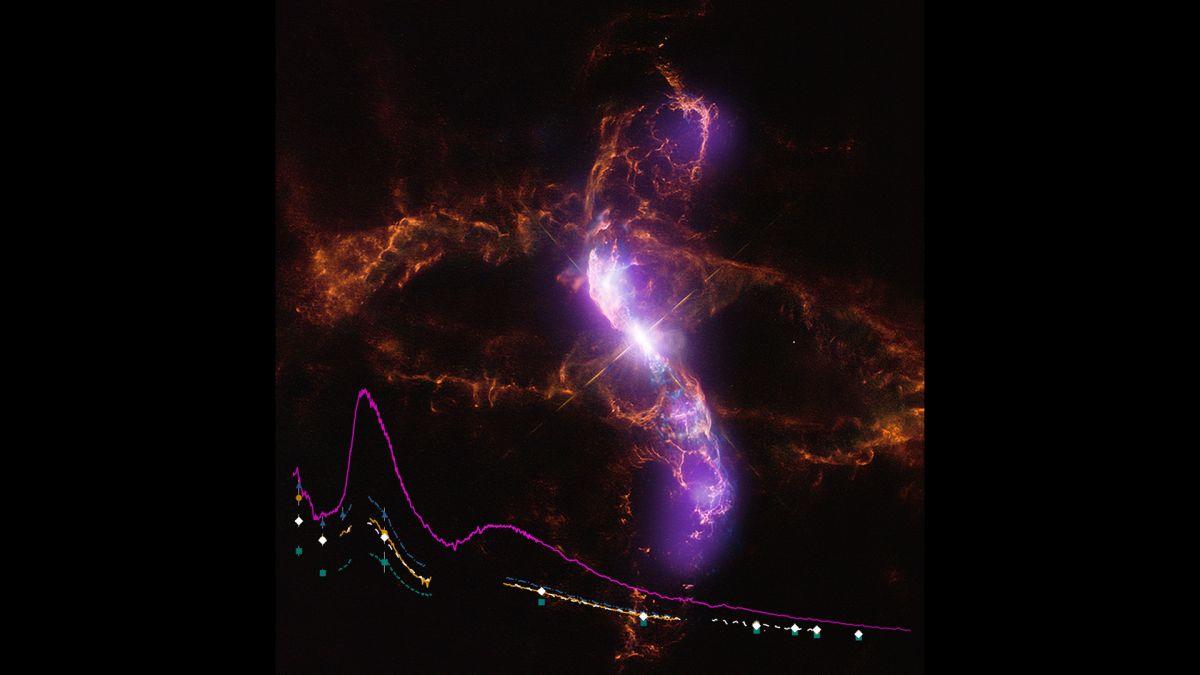
NASA’s flying telescope SOFIA has been watching a dance between two stars orbiting each other as they approach the moment of eclipse, allowing astronomers to study how the two exchange stardust.
SOFIA, short for “Stratospheric Observatory for Infrared Astronomy,” has observed the binary star R Aquarii, located in the constellation Aquarius some 720 light-years away from Earth, since 2018, when the smaller of the two stars in the system started eclipsing the brighter star from the perspective of Earth..
Astronomers believe that the smaller of the two stars is a white dwarf, a dim, cooling remnant of a star that has run out of fuel. The brighter of the two stars in the R Aquarii binary is a type of pulsating star called a Mira variable, which dims and brightens over a relatively long period of time of 387 Earth days.
As SOFIA turned its gaze to R Aquarii, the binary star was not only going through the eclipse but also nearing its periastron, the moment when the two bodies are at their shortest distance from each other.
The combination of these two events, which occurs every 43.6 Earth years as the white dwarf completes one orbit around the larger star, enabled SOFIA to observe how the two stars exchange dust, a phenomenon that is otherwise obscured by the glow of the larger star.
Astronomers know that stardust escapes from the larger star and gets accreted by the white dwarf, but they rarely get the chance to see it with their own eyes.
“It’s an opportunity to see it in a unique way, because the material that’s being accreted isn’t obscured by the Mira; it’s right out in front,” Steven Goldman, a scientist with the Universities Space Research Association, based at NASA’s Ames Research Center in California, said in a statement (opens in new tab). Goldman is a co-author of a new paper describing the observations.
The flow of dust between the two stars changes as the distance between them shifts during their elliptical orbits. Around periastron — which, luckily for the astronomers, coincides with the eclipse — the white dwarf is sucking in the most dust from the brighter star.
The findings of the study reveal previously unknown information about the inner workings of not just the R Aquarii binary star system but also of millions of other similar binaries that are scattered across our Milky Way galaxy, the statement said.
“So, the real excitement here is that you’re getting something that is on a human timescale probing very fundamental aspects of astrophysics,” Ravi Sankrit, an astronomer at the Space Telescope Science Institute in Baltimore and first author of the paper, said in the statement.
Related stories: — ‘Symbiotic stars’ caught snacking on each other outside the Milky Way — Triple-star system’s strange antics entrance scientists digging through 125 years of data — Extraterrestrial life may be common around binary stars
The SOFIA observatory, a joint project involving NASA and the German Space Agency DLR, is a 106-inch (2.7 meters) telescope that flies aboard a Boeing 747 aircraft. The plane can take the telescope to altitudes of up to 45,000 feet (13.7 kilometers), above the thickest layer of Earth’s atmosphere, where its observations are less distorted.
Earlier this year, NASA and DLR decided to shut down the mission, after it received no funding in the White House’s fiscal year 2023 budget request. SOFIA is expected to take to the sky for the final time by the end of September.
The paper (opens in new tab) was published in the journal Astrophysical Journal in February.