

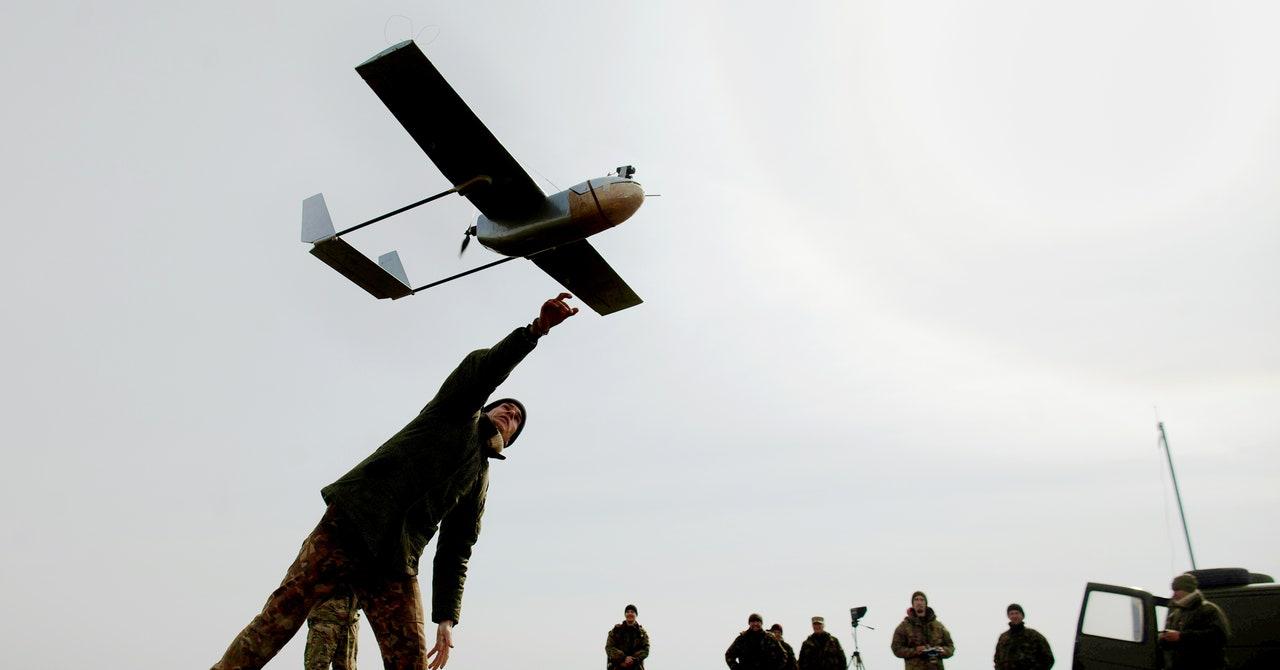
In the snowy streets of the north Ukrainian town of Trostyanets, the Russian missile system fires rockets every second. Tanks and military vehicles are parked on either side of the blasting artillery system, positioned among houses and near the town’s railway system. The weapon is not working alone, though. Hovering tens of meters above it and recording the assault is a Ukrainian drone. The drone isn’t a sophisticated military system, but a small, commercial machine that anyone can buy.
Since Vladimir Putin invaded Ukraine at the end of February, drones of all shapes and sizes have been used by both sides in the conflict. At one end of the scale are large military drones that can be used for aerial surveillance and to attack targets on the ground. In contrast, small commercial drones can be flown by people without any specific training and carried around in a suitcase-sized box. While both types of drones have been used in previous conflicts, the current scale of small, commercial drone use in Ukraine is unprecedented.
Drone videos shared and posted to social media depict the brutality of the war and reveal what has happened during battles. Drones have captured fighting in the destroyed Ukrainian city of Bucha, with lines of tanks moving around streets and troops moving alongside them. Commercial drones have helped journalists document the sheer scale of destruction in Kyiv and Mariupol, flying over burnt-out buildings that have been reduced to rubble.
Russian troops have been caught on camera allegedly shooting at citizens holding their hands in the air. Drone videos show Ukrainian troops shelling Russian positions, monitoring their movements in real time, and ambushing Russian troops. In one video, a drone spots Russian military vehicles leaving troops behind—they run after the transport and fall in the snow. In another, the drone hovers in the air and records a helicopter being shot down as it flies past.
“Drones changed the way the war was supposed to be,” says Valerii Iakovenko, the founder of Ukrainian drone company DroneUA. “It is all about intelligence, collecting and transferring data about enemy troops’ movements or positionings, correcting artillery fire. It is about counter-saboteurs’ actions, and it is of course search-and-rescue operations.” Iakovenko estimates that Ukrainian forces are operating more than 6,000 drones for reconnaissance and says these can link up with Elon Musk’s Starlink satellite systems to upload footage. “In 2014, drones became the center of attention of intelligence units, but their scale cannot be compared to what we see today,” he says. (Russia first began its invasion of Ukraine in 2014 with its annexation of Crimea.)
Both Ukraine and Russia have used military drones during the war—and Ukraine received donations of drones from the US. These military drones can often fly at high altitudes for long periods of time and fire upon targets, including ships. However, the use of smaller commercial drones in such high numbers stands out, researchers say. These drones, which can sometimes be flimsy and can’t fly far from their operators or stay in the air for long periods, have provided tactical advantages in some cases. (Commercial drones have been used in previous conflicts, for instance in Syria, but not as extensively as in Ukraine.)
Civilian drone researcher Faine Greenwood has tracked and logged almost 350 incidents in which consumer drones have been used in Ukraine, with the video footage shared on Twitter, Telegram, YouTube, and other social media. Many of the clips, which Greenwood has also mapped, are recorded by military forces, but others have been captured by civilians and journalists. The documented incidents are likely to be only a small fraction of the drone usage in Ukraine. Iakovenko says that in addition to collecting footage for possible war crimes, drones are being used to inspect buildings that have been hit and to help restore power supplies that have been damaged or knocked out.
“You get cheap airborne surveillance, or even strike capabilities, by using these,” says Ulrike Franke, a senior policy fellow at the European Council on Foreign Relations who has studied the use of drones in war. The drones allow troops on the ground to immediately surveil forces around them, retarget weapons, and take action that could stop enemy advances or save lives. “You have individuals or small militia groups that all of a sudden have their own airborne surveillance capability—that’s something you wouldn’t have had 10 years ago. There certainly have been tactical advances and tactical victories because of that.”
Beyond providing direct surveillance that can contribute to intelligence, the videos being captured by consumer drones could contribute to accountability after the war ends. “This is one of the first cases we have had where drones have collected so much really applicable information for war crimes investigations against civilians,” Greenwood says. Although there are questions about what kinds of footage will be admissible in trials, Greenwood and others are backing up and saving video from drones in Ukraine.
Chief among the commercial drones being used in Ukraine are those from Chinese firm DJI, particularly its Mavic line of devices. Its consumer drones are considered to be some of the easiest to purchase and fly. Both Ukrainian and Russian forces have been seen using the drones, Greenwood says. Early in the war, Ukrainian authorities accused DJI of allowing Russian forces to use its drone detection system to target troops, although the company strongly denies this and no strong evidence has been presented.
At the end of April, DJI announced it was temporarily suspending sales in both Russia and Ukraine. The company has consistently said it doesn’t market its products for military use, and it has refused to enable modifications that would allow such use. “DJI has taken this action not to make a statement about any country, but to make a statement about our principles,” DJI spokesperson Adam Lisberg says. “DJI abhors any use of our drones to cause harm, and we are temporarily suspending sales in these countries in order to help ensure no one uses our drones in combat.”
Despite DJI’s opposition to military uses of its products, the drones have been weaponized during the war. “I don’t think people have expected commercial DJI drones to be used at such scale,” says Samuel Bendett, an advisor with nonprofit research organization CNA who focuses on Russia and unmanned and autonomous military systems. “This raises the question of whether drone proliferation can be stopped altogether in any conflict.” Charities, companies, and individuals have donated consumer drones from around the world to Ukrainian forces. (Greenwood says they have seen claims that the Russian military is being supplied with donated drones, too. They also point out Telegram messages that claim to show pro-Russian fighters discussing the use of commercial drones).
While the use of consumer drones in conflicts is not new, the machines are not designed for a hostile environment. “The downside of these drones is that they’re not military-grade,” Bendett says, adding they can be targeted by anti-drone technology designed to take them out of the sky. All the drone specialists we spoke to for this article say they haven’t seen as many incidents of drones being shot out of the sky as they would have expected—particularly by Russian forces.
“Flying a simple commercial drone in conflict puts the operators in danger as well,” Bendett says. Civilians, journalists, and humanitarian workers using drones in Ukraine are being put at greater risk when they fly consumer drones, Greenwood adds. “The big problem with consumer drones and conflict zones, which humanitarian aid workers are very conscious of, is that you can’t tell them apart; they look exactly the same.” A consumer drone being flown by a civilian appears no different from the same drone being flown by a soldier.
This means there are questions about what will happen under humanitarian laws if people flying drones are targeted, Greenwood says. “What happens if an aid worker is flying a drone and people assume it’s a drone, it must be being flown by a combatant, and therefore this is a valid target and I’m going to kill it?”